Thien Mu Pagoda – The Greatest Ancient Temple in Hue
Thien Mu Pagoda, a temple with a history of over 400 years located along the Perfume River, serves as evidence of the allure of spiritual beauty, architecture, and nature. Join Deluxe Group Tours to explore what this ancient temple has to offer, captivating the hearts of countless travelers who come here

Overview of Thien Mu Pagoda in Hue.
1. History
Thien Mu Pagoda, also known as Linh Mu Pagoda, was commissioned by Lord Nguyen Hoang in 1601. The pagoda is situated on the northern bank of the Perfume River in the Huong Long commune, 5km from the center of Hue City. According to historical records, Lord Nguyen Hoang personally traveled to Thuan Hoa Province (present-day Thua Thien Hue Province) to inspect and prepare for the construction plans and the family’s legacy. While riding a horse along the Perfume River, he came across Ha Khe Hill. Seeing its resemblance to a dragon turning its head, Lord Nguyen was determined to build a temple on the hill facing the river and called it Thien Mu.
In 1862, with the desire for a male heir to continue the royal lineage, King Tu Duc changed its name to Linh Mu, fearing that “Thien Mu” (celestial lady) might offend the heavens. It wasn’t until 1869 that this fourth king of the Nguyen dynasty reverted to the original name, Thien Mu. However, today, people still refer to the ancient temple by both names.
The Pagoda Pagoda has undergone numerous restoration phases, with one of the most prominent renovations taking place during the reign of Lord Nguyen Phuc Chu (1691–1725). During this period, Lord Nguyen Phuc Chu cast a bell weighing over two tons, featuring inscriptions of Buddhist scriptures. Around 1714, he continued the restoration of other structures like Thien Vuong Palace, Thuyet Phap House, and Tang Kinh Pavilion.
Lord Nguyen Phuc Chu also sent people to China to acquire more than a thousand sets of Buddhist scriptures. Everything he did aimed at praising the philosophy of Buddha, with all the scriptures stored in the Tang Kinh Pavilion. Additionally, there was a set of scriptures providing detailed information about Venerable Thach Liem, who played a significant role in helping the Nguyen dynasty establish Buddhism in the region.
2. The legend of Thien Mu Pagoda
The Thien Mu Pagoda in Hue is a symbol of Hue closely associated with the Ancient Capital throughout the ages. With a lifespan of over 400 years, it is also one of the most frequently mentioned landmarks in city exploration. It is not only a sacred destination for Buddhists but also carries a legacy of a love curse.
According to folklore, during the rule of the Nguyen dynasty, the concept of “where parents place, where the child sits” weighed heavily. There was a couple in love, but due to their different social statuses, they could not be together. In agony, they decided to commit suicide at the Thien Mu wharf. Only the young man died, while the girl was rescued and later forgot the memories. The young man, lying beneath the river, awaited his lover but never saw her, harboring resentment. Consequently, he entered the Thien Mu Pagoda, casting a curse that every couple coming here would part ways.
However, the monks at Thien Mu Pagoda assert that this love curse is not real. The folklore spreads this tale as a cautionary lesson to couples, reminding them not to exploit the temple grounds to maintain the tranquility and solemnity of the pagoda.
Refer to tour programs that visit Thien Mu Pagoda : Hue Group Tour
Explore prominent architectural structures in Thien Mu Pagoda.
1. Phuoc Duyen Tower
Phuoc Duyen Tower is a must-visit checkpoint when traveling to Thien Mu Pagoda in Hue. This structure was built right after the entrance gate area. Although located in the front, the Phuoc Duyen Tower is considered the “soul” of the pagoda.
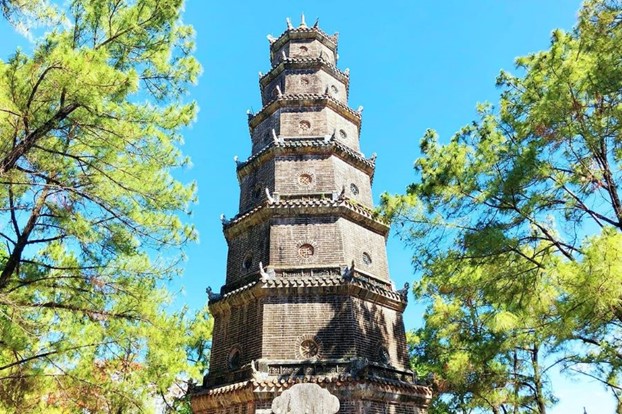
The Phuoc Duyen Tower was constructed in 1844 by King Thieu Tri. It was named Tu Nhan Tower before becoming known by its current name. At that time, to complete the tower, materials such as clay, blue stone, and Bat Trang ceramics had to be transported from Tonkin.
The tower’s body is built with wooden bricks, and the surrounding walls are constructed with blue stone. Altogether, they form an octagonal-shaped tower, narrowing as it goes higher, with a total of 7 floors, each 2 meters high. Overall, the design of each floor is identical and painted pink. Over the years, it has acquired the marks of time, further enhancing the distinctive value of the Ancient Capital’s architecture.
2. Tam Quan Gate (three-arched-entrances gate)
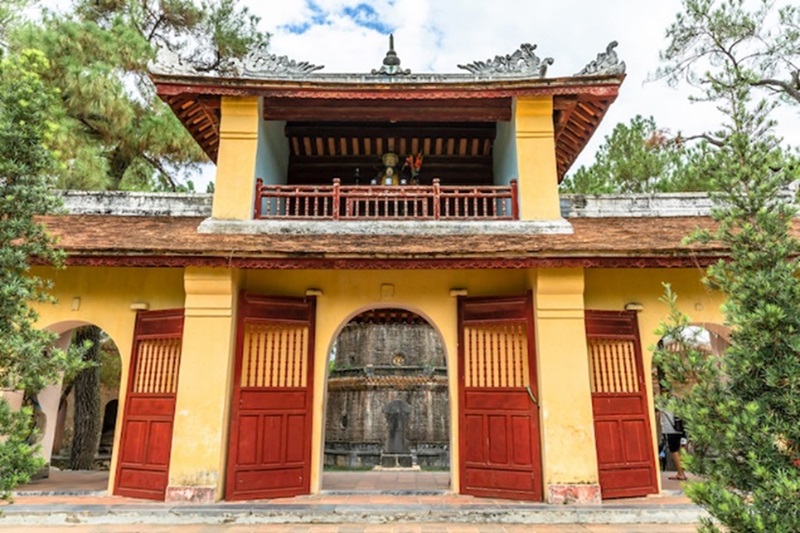
Tam Quan Gate is the main entrance of the pagoda, located behind the Phuoc Duyen Tower. The gate has three paths, symbolizing the three realms: human, demon, and deity. The gate is designed with two floors and eight roofs. There is a Buddha altar on the second floor of the central gate. The top of the roof is adorned with many unique floral patterns. On both sides of the pathways, there are guardian statues.
3. Dai Hung Shrine
Located right in the main hall of Thien Mu Pagoda in Hue, Dai Hung Shrine is dedicated to worshiping Maitreya Buddha, the deity of carefree joy. The statue depicts Maitreya Buddha with a gentle demeanor, large and elongated ears symbolizing receptivity, a generous belly representing tolerance, and a warm, benevolent smile. The palace is entirely constructed with specialized cement. Besides being painted to resemble wood, it gives a sense of intimacy and familiarity.
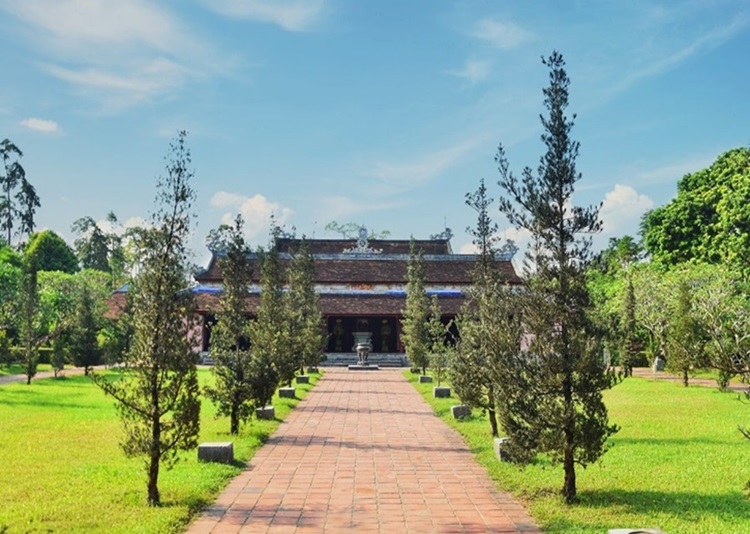
Dai Hung Shrine not only showcases Maitreya Buddha but also serves as a repository for a large self-portrait dating back to 1974 and an intricately crafted bronze moon-shaped bell. Going deeper inside, there is a shrine with the Three Jewels Buddha statue at the center, Van Phu Bodhisattva on the left, and Pho Hien on the right. Particularly noteworthy is the area of land behind Dai Hung Shrine, which serves as the burial place of the venerable Thich Don Hau, the abbot of the pagoda.
4. The tomb tower of the Venerable Thich Don Hau
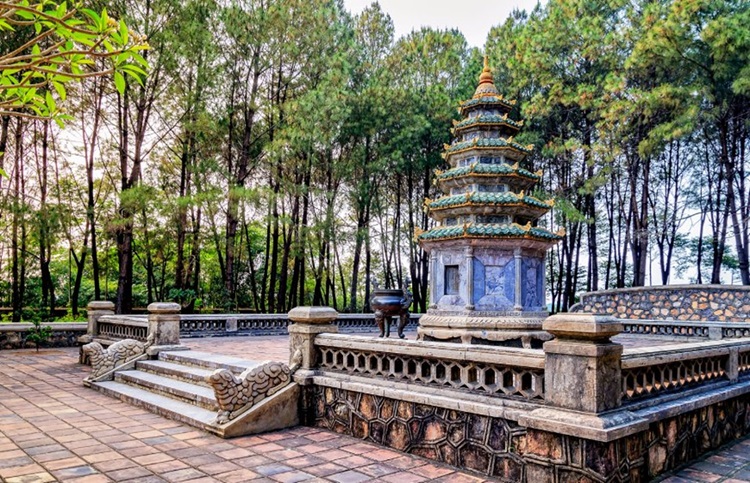
Venerable Thich Don Hau is a renowned abbot in the temple. He devoted his entire life to the development of Buddhism in Vietnam. In addition, he is respected by the people for his numerous charitable activities and assistance to those in need. Upon his passing, the community and the temple authorities buried Venerable Thich Don Hau under the six-floor tower at the end of the temple grounds as a gesture of gratitude and reverence for the esteemed monk.
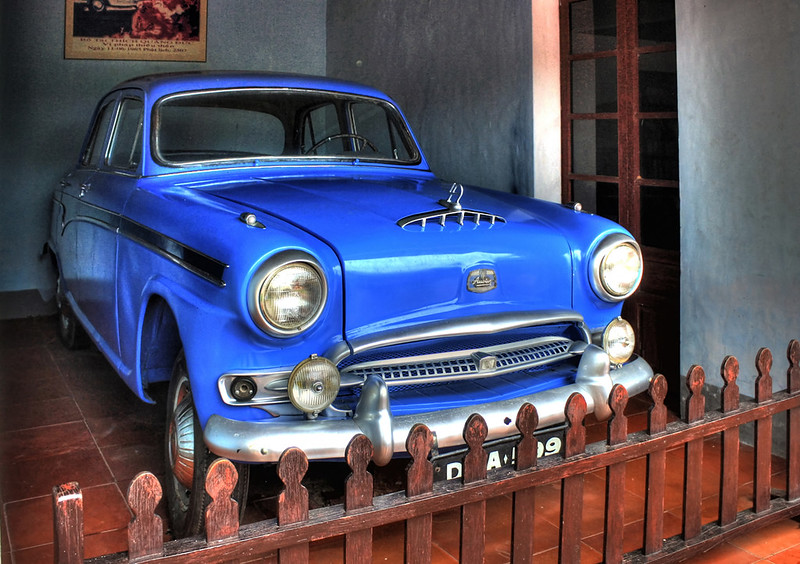
5. Austin Car vehicle of Thích Quảng Đức
Thien Mu Pagoda also has a remarkable space where the Austin car is kept, the car that transported Venerable Thich Quang Duc to the self-immolation site. Venerable Thich Quang Duc self-immolated with gasoline at a busy intersection in Saigon on June 11, 1963, to protest the oppression of Buddhism by the government of the Republic of Vietnam under Ngo Dinh Diem.
Source: https://www.flickr.com/photos/danielmennerich/49289976931
The car originally belonged to a Buddhist follower of Thien Mu Pagoda named Tran Quang Thuan (Dharma name Tam Duc). The car had a connection with the Buddhist cause when it was borrowed to transport Venerable Thich Quang Duc from An Quang Pagoda to the intersection of Phan Dinh Phung and Le Van Duyet. Subsequently, the Saigon police confiscated the car as evidence. In 1964, Mr. Thuan donated it to Thien Mu Pagoda, and the monks at the pagoda submitted a request to bring the car back for display as a relic. The Austin car was then transported from Saigon to Hue, where it has remained ever since.
Other tourist activities at the pagoda.
1. Admire the scenery of the Perfume River from the pagoda.
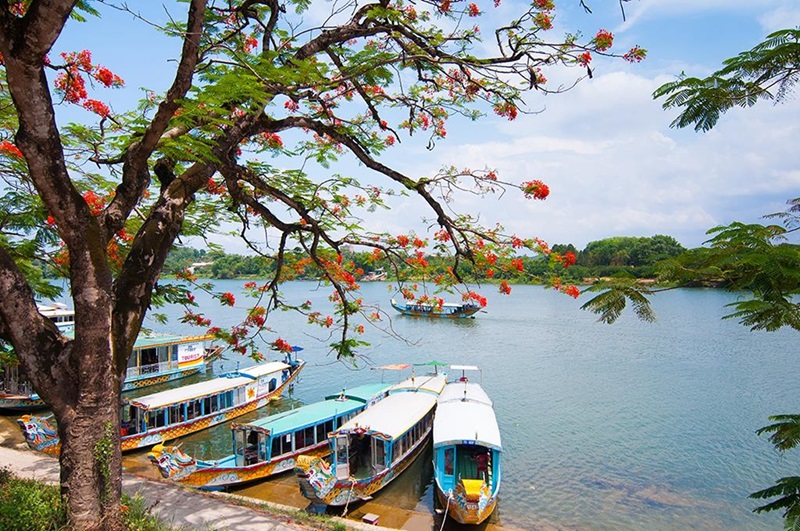
Thien Mu Pagoda is also an ideal place for sightseeing. After spending time at the pagoda, you can relax and admire the tranquility of the Perfume River, with dragon boats docking in front of the pagoda, creating a serene and quiet space. The scene of the silent boats landing in front of the pagoda harmonizing with the river, covered by the sunset, will leave a deep impression in your heart.
2. Eat hot tofu pudding (tofu in ginger syrup).
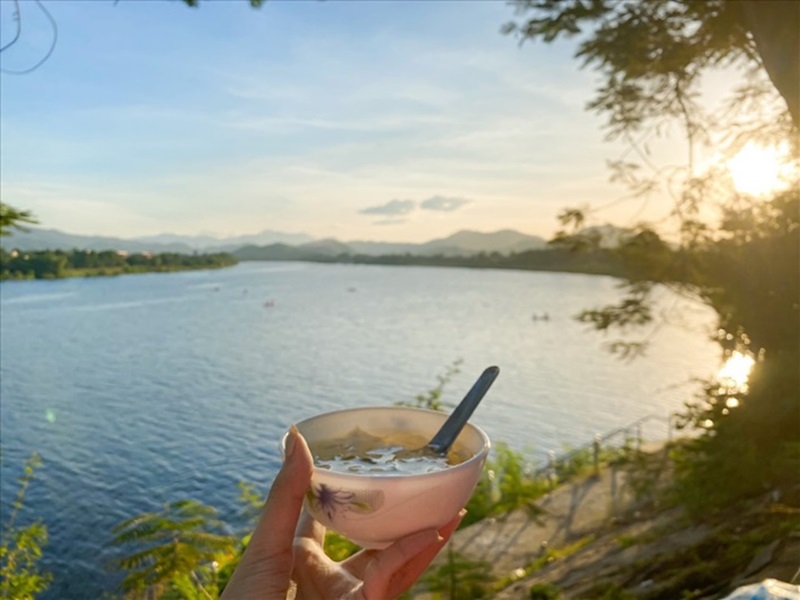
Another activity that locals enjoy is savoring a bowl of tofu pudding to recharge their energy after exploring the vast landscapes of the pagoda. Tofu pudding in Hue is enhanced with a bit of crushed or thinly sliced ginger, giving it a fragrant and slightly spicy flavor, complemented by a touch of sugar syrup. The tofu pudding is scooped into small pieces, and during the winter, it is often enjoyed hot, while in the scorching summer, a few ice cubes are added to bring refreshing relief.
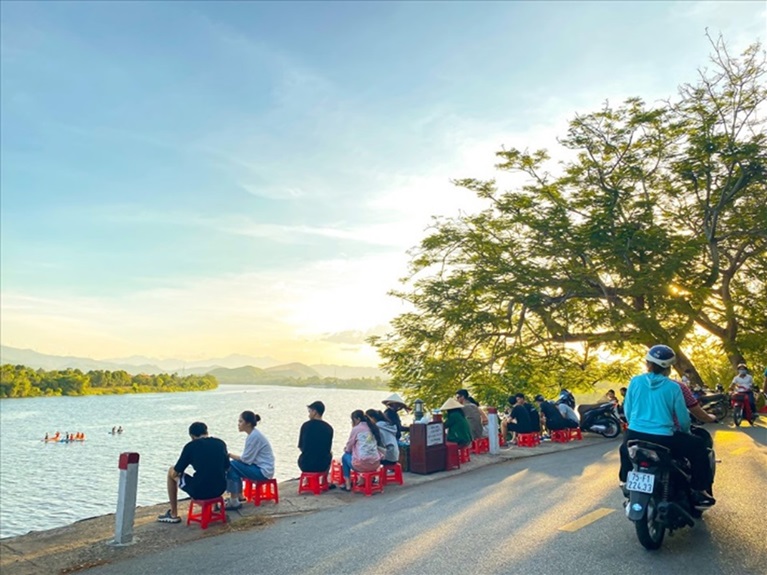
At the foot of Thien Mu Pagoda, the humble tofu pudding vendors become remarkably unique and poetic. Every visitor to this place has their reasons for coming. At Thien Mu Pagoda during the late afternoons, you will find nothing more delightful than relishing a bowl of tofu pudding while admiring the picturesque sunset over the Perfume River and the panoramic view of green mountains and azure waters.
Thien Mu Pagoda travel
1. Location and moving instruction
The pagoda is open from 8 a.m. to 6 p.m., and admission is free. It is conveniently located just 5 kilometers from the city center on Nguyen Phuc Nguyen Street, so you can explore the pagoda leisurely and visit it using any means of transportation.
- Motorbike: You can rent a motorbike for around 80,000–150,000 VND per day for the convenience of sightseeing and having the flexibility to manage your time. You can follow this route: From the center of Hue, take Dang Thai Tan Street, turn left onto Yet Kieu Street, then take a right onto Le Duan Street. Turn right at the roundabout onto Kim Long Street, and after about 2 km, you will reach Thien Mu Pagoda.
- Bicycle: You can rent a bicycle for a leisurely ride to Thien Mu Pagoda, as the route is beautiful and relatively short. However, if you choose to ride a bike, it’s advisable to do so early in the morning to avoid the intense midday sun and to be mindful of the busy traffic on the roads.
- Boat: Taking a dragon boat along the Perfume River for about 30 minutes to reach Thien Mu Pagoda, enjoying the cool breeze along the riverbank and the beautiful scenery, is a unique and recommended method of transportation.
2. Best time to visit
With the harsh weather in Hue, there are two optimal periods to visit tourist attractions in Hue in general and Thien Mu Pagoda in particular. These are during January and February, when the weather in Hue is extremely pleasant, with cool temperatures and little rainfall. Additionally, May and June are also popular times for people to visit Thien Mu Pagoda and the ancient capital of Hue. During this period, visitors can enjoy the sight of the pagoda surrounded by vibrant red flamboyant flowers in full bloom across the sky.
3. Travel Tips
- To maintain a serene and holy environment, move slowly, talk at a small volume, avoid causing disturbance, and don’t use foul language when on temple
- When dressing for a visit here, go for something elegant, courteous, and modest. Avoid wearing garments or skirts that are too short or exposed. This advice applies to various temples in addition to Thien Mu Pagoda.
- Many stalls outside the temple offer trinkets, jewelry, conical hats, traditional clothes (Áo dài), and other memorabilia as souvenirs. You can select and fairly haggle over pricing.
- It is advised to carry water to avoid dehydration during the trip, as the visit may take up to two hours with a lot of walking, and the temple may not have open food and drink stands.
Recommend nearby tourist destinations
Thien Mu Pagoda is a well-known tourist attraction in Hue. However, when you visit Thien Mu Pagoda, don’t miss out on other beautiful tourist spots nearby.
- Vong Canh Hill: Vong Canh Hill offers a great experience and picturesque views of nature harmonized with grass, rolling hills, and a gentle river, especially when you choose to admire the sunset. It is considered the best location to immerse yourself in a tranquil and relaxing space.
- Dong Ba Market: Dong Ba Market is the ideal place where you can both buy souvenirs and enjoy specialties from Hue.
- An Hien Garden House: An Hien Garden House is where you can experience the antiquity of a traditional garden steeped in the distinctive cultural imprint of Hue.
View Thien Mu Pagoda 360
Thien Mu Pagoda Map Location
Hue city Tour 1 day - Hue city Tour one day - Hue tour 1 day - Hue Tour oneday
Frequently Asked Questions(FAQ)
When is Thien Mu Pagoda open?
Thien Mu Pagoda is open: Sun – Sat. Opening hours: 6:00:18:00. The most pleasant weather in Hue is from January to March.
How much is Thien Mu Pagoda entrance fee?
Thien Mu Pagoda don’t have Entrance Fee. This is a ticket free attraction.
How far is Thien Mu Pagoda from Hue city center?
Thien Mu Pagoda is about 4km from Hue City Center. It is located on Huong Long village, North bank of Perfume River
How to get to Thien Mu Pagoda?
Thien Mu Pagoda can be reached by tours, Motorbike, bicycle, cyclo drivers from Hue center.


